
The frontier wars of the American Revolution weren’t just fought on distant battlefields between uniformed armies, they were brutal, close-quarters struggles that determined whether settlers could hold their ground in Kentucky and beyond. The Blue Licks Battlefield stands as one of the most pivotal moments in this often-overlooked chapter of American history. On August 19, 1782, what began as a pursuit of Native American raiders turned into a devastating ambush that reshuffled the balance of power in the Kentucky frontier and became the last major battle of the Revolutionary War. Understanding what happened at Blue Licks means understanding how America’s westward expansion actually unfolded, through blood, strategy, and the determination of frontier fighters who understood that losing ground here meant losing everything.
Key Takeaways
- The Blue Licks Battlefield in Kentucky (August 19, 1782) was the last major battle of the Revolutionary War frontier, where militia were ambushed while pursuing a Native American war party, resulting in approximately 70 American casualties.
- Despite the American militia’s devastating defeat at Blue Licks Battlefield, the loss ultimately galvanized frontier communities and shifted strategic resources to Kentucky, accelerating American westward expansion after the 1783 peace treaty.
- Kentucky’s control during the Revolutionary era determined the future of American westward expansion, making the Blue Licks Battlefield a proving ground between British-allied Native American forces defending their territorial interests and American settlers seeking new land.
- The Blue Licks Battlefield State Historic Site preserves 100 acres of the original battleground with a visitor center, interpretive exhibits, and guided tours that help visitors understand how terrain and tactical positioning directly influenced the outcome of this frontier engagement.
- The battle at Blue Licks demonstrated that frontier warfare during the Revolution was fundamentally different from formal battles—fought by militia in close-quarters combat over settlement and resource control rather than by professional armies over political objectives.
What Was the Blue Licks Battlefield?
The Blue Licks Battlefield is a site in Robertson County, Kentucky, where one of the Revolutionary War’s most significant frontier engagements took place. Located near the Licking River, this spot became historically important because it was a natural gathering point, settlers, hunters, and military forces all had reason to pass through or defend this strategic location. The terrain features a lick, which is a natural salt deposit that animals and humans used as a resource, making the area economically and strategically valuable.
Today, the Blue Licks Battlefield State Historic Site preserves this ground and tells the story through restored structures, artifacts, and interpretive exhibits. Visitors can walk the grounds where militia members and Native American fighters clashed, see the layout that made the ambush so devastating, and engage with how frontier warfare actually unfolded. The site documents not just the military clash but the broader experience of frontier life during the Revolutionary era, the constant raids, the pressure on settlements, and the complex relationships between different groups competing for control of Kentucky.
The Historical Context: Why This Battle Mattered
The American Revolutionary War on the Frontier
Most people think of the Revolutionary War as a conflict between colonial armies and British redcoats in places like Yorktown or Valley Forge. But on the frontier, the fighting was different. It was messier, more personal, and fought largely by militia instead of professional soldiers. Native American groups allied with the British, while settlers and American militia pushed deeper into Kentucky territory. The war wasn’t about controlling cities or holding formal battle lines, it was about who would control the land and the resources that came with it.
The frontier version of the Revolution lasted longer too. While the main armies signed peace in 1783, the fighting on the Kentucky frontier continued into 1782 and beyond. Raids and counterraids created a cycle of violence that shaped the entire region. Settlers didn’t just fight for independence: they fought for survival and the right to expand westward.
The Importance of Kentucky During the Revolutionary Era
Kentucky was the prize everyone wanted. It held vast lands for settlement, abundant game for hunting, and strategic value for controlling the interior of North America. Before the Revolution, Kentucky was mostly a hunting ground, few permanent settlements existed. But as the war progressed, settlers pushed into Kentucky looking for fresh land and opportunities. The British and their Native American allies wanted to keep American expansion checked: they saw Kentucky as a buffer zone and a crucial territory for their own interests.
Control of Kentucky meant control of the frontier’s future. If the British and their allies could maintain dominance, they could prevent American westward expansion. If American settlers and militia could secure the region, they’d solidify the new nation’s territorial claims. The Blue Licks Battlefield became the proving ground for this larger struggle. IGN’s coverage of historical games sometimes touches on how real military conflicts like Blue Licks shaped gameplay mechanics in strategy titles, illustrating how even entertainment media draws from these pivotal moments.
The Battle of Blue Licks: What Actually Happened
The Buildup: Raids and Tensions in 1782
By August 1782, tensions on the Kentucky frontier were at a breaking point. Native American war parties, supported by the British from their base in Detroit, had been conducting raids against settlements throughout the summer. These weren’t small skirmishes, they involved dozens of fighters and targeted communities trying to establish themselves in Kentucky. The raids created constant fear and instability. Settlers gathered in fortified stations for protection, but that meant their fields went unfarmed and their livestock unattended, threatening their survival through the coming winter.
Militia units throughout Kentucky were on high alert. They knew raids were coming: they just didn’t know when or where. The constant pressure pushed militia leaders to abandon defensive tactics and go on offense. When scouts reported a significant Native American war party moving through the region, militia commanders saw an opportunity. Instead of waiting in fortifications, they could pursue and defeat a major raiding force in the field. It seemed like a chance to finally take control back from the raiders.
August 19, 1782: The Day of Battle
On August 19, a force of approximately 180 militia members from Kentucky settlements moved out to intercept a reported war party of Shawnee, Delaware, and other Native American fighters. The pursuit took them to the Blue Licks, where the Licking River created a natural bottleneck. The militia advance was fast and aggressive, commanders were eager to catch the raiders before they could slip away into the wilderness.
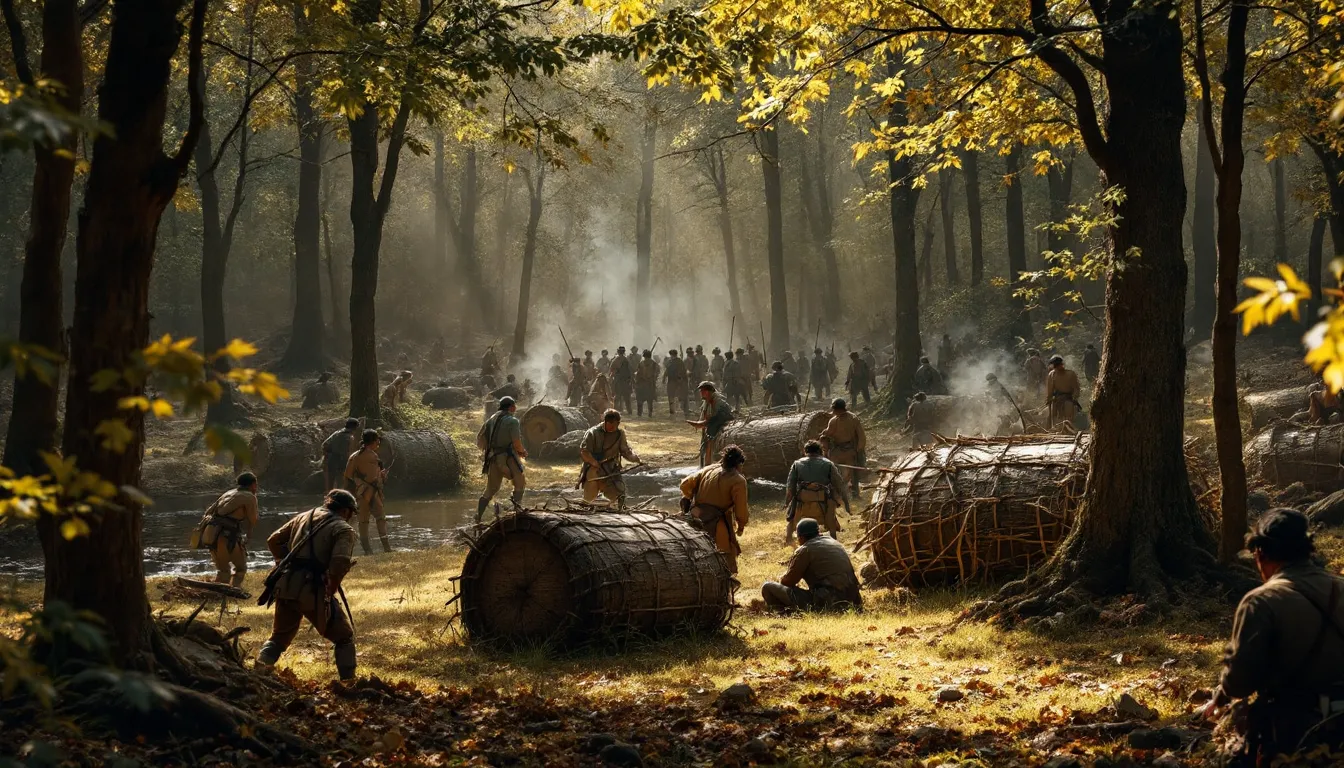
What the militia didn’t know was that the enemy forces had set a trap. Instead of running, the war party was waiting. As the militia crossed the ford at Blue Licks and climbed up the opposite bank, they found themselves in a perfect ambush position. Concealed fighters opened fire from the surrounding heights and forest, catching the militia in a devastating crossfire. The initial volley killed or wounded dozens of Americans. What should have been a pursuit turned into a chaotic fight for survival.
The militia held their ground initially but couldn’t overcome the tactical disadvantage. After fierce fighting that lasted roughly one to two hours, militia members broke and retreated. The enemy forces, having accomplished their objective, didn’t pursue aggressively into unknown territory. The battle ended with the Americans in retreat and the Native American and British forces in control of the field.
Key Figures and Military Leadership
The militia force was led by several experienced frontier commanders, including Daniel Boone, the legendary frontiersman. Boone was already well-known for his knowledge of the Kentucky wilderness and his role in establishing settlements. But, even his experience and reputation couldn’t overcome the tactical surprise at Blue Licks. Other officers like Captain John Holder and militia leaders from various settlements played crucial roles in trying to organize resistance during the chaotic fighting.
On the opposing side, the war party was led by experienced Native American commanders operating in coordination with British officers overseeing frontier operations from Detroit. The specific command structure varied, but the coordination and tactical awareness they displayed at Blue Licks showed military competence and strategic thinking. The ambush wasn’t luck, it was deliberate planning. The Loadout’s tactical guides emphasize similar ambush positioning and crossfire mechanics in competitive shooters, principles that apply directly to how real military engagements unfold.
Strategic Significance and Outcomes
The Aftermath and Casualty Count
The battle at Blue Licks resulted in approximately 70 militia killed and several dozen wounded. For a frontier community, these losses were catastrophic. Every militia member was also a settler, a farmer, or someone essential to the community’s survival. Entire families were affected. Some of the most respected frontier figures died at Blue Licks, and their deaths resonated throughout Kentucky settlements.
The Native American and British forces suffered fewer casualties but also withdrew from the area afterward. They didn’t pursue into Kentucky settlements to capitalize on their victory, partly because they understood their own supply lines and the challenges of extended operations far from their bases. The aftermath left Kentucky temporarily more dangerous but didn’t result in a complete British takeover of the region.
How This Battle Changed the Frontier War
Countintuitively, Blue Licks became a turning point in the opposite direction from what the victory might suggest. Yes, the militia suffered a serious defeat. But the battle galvanized the frontier communities and the American government into recognizing Kentucky’s strategic importance. Reinforcements and supplies that might have been allocated elsewhere were redirected to Kentucky defense. Militia training improved, and frontier commanders became more cautious about overextending themselves in pursuit of enemies.
The broader significance lay in the fact that Blue Licks was the last major battle of the Revolutionary War era on the frontier. After August 1782, while raids continued, the pattern of large-scale military engagements shifted. The peace treaty signed in 1783 officially ended British involvement, removing the coordinating force behind the Native American raids. Within a few years, the frontier balance shifted decisively in America’s favor. By 1784-1785, American settlement and expansion into Kentucky accelerated dramatically.
Historically, Blue Licks mattered because it marked the end of one era and the beginning of another. It wasn’t a triumphant American victory, but it was the last gasp of the British-led frontier strategy to contain American expansion. After Blue Licks, the trajectory of westward movement became nearly unstoppable. DualShockers’ historical analysis pieces occasionally examine how watershed moments like Blue Licks appear in period-specific games, showing how this battle’s legacy extends into modern media representation.
Blue Licks Battlefield Today: Visiting and Learning
The Blue Licks Battlefield State Historic Site
The Blue Licks Battlefield State Resort Park preserves the historic ground and offers visitors a chance to walk the terrain where this pivotal moment unfolded. The park sits on approximately 100 acres, giving visitors room to explore and understand the geographic layout that made the battle possible. Visitors can see the ford where militia crossed, the heights where ambush positions were set, and the general topography that militia commanders had to navigate.
The site features a visitor center with interpretive displays, artifacts recovered from the battlefield, and detailed explanations of what happened and why it mattered. The displays aren’t just military, they contextualize the broader frontier experience, showing how settlers lived, what they faced, and what communities had to endure. There are also Blue Licks Battlefield State Resort Park photos available online that give visitors a preview of the landscape and facilities before they arrive.
The park amenities go beyond just historical education. There’s camping, picnic areas, a lake for fishing, and hiking trails that let visitors experience the landscape as frontier travelers might have. Many visitors find that walking the actual terrain gives them a visceral understanding of the terrain’s strategic value and the challenges soldiers faced maneuvering across rough ground.
Educational Resources and Exhibits
Beyond the physical site, several educational resources help explain the Blue Licks Battlefield’s significance. The visitor center offers guided tours during peak seasons, with knowledgeable interpreters who can answer detailed questions and provide context that plaques alone can’t convey. Educational programs target school groups and can integrate the battle into broader lessons about the American Revolution, frontier history, and westward expansion.
Blue Licks Battlefield State Resort Park reviews from educational groups consistently praise the site for its ability to bring history to life. Teachers find that visiting the actual battlefield helps students understand how geography, terrain, and tactical positioning directly affect the outcomes of military engagements. It’s one thing to read about an ambush: it’s another to stand at the location and see how the terrain made that ambush inevitable.
Local historical societies and university researchers continue to study Blue Licks, adding new interpretations and filling in details about the battle and the broader frontier war. Artifact analysis, historical documents, and oral traditions from descendants of those who fought there provide ongoing enrichment to our understanding of what happened and why it mattered.
Conclusion
The Blue Licks Battlefield represents a crucial but often overlooked moment in American history. It wasn’t a grand engagement between regular armies with thousands of troops or dramatic flag-raising ceremonies, it was a brutal frontier fight that determined whether American expansion westward would continue or be checked by British and Native American forces. The battle’s legacy extends far beyond Kentucky: it marked the point where the Revolutionary War’s frontier chapter began its final phase, setting the stage for American dominance over the interior continent.
Visiting the Blue Licks Battlefield State Historic Site today offers more than just a historical pilgrimage. It’s a chance to understand how terrain, timing, and tactical decisions shape outcomes. It’s a reminder that the American frontier wasn’t won through inevitable progress or manifest destiny, it was fought yard by yard by men who faced real consequences and suffered genuine losses. For anyone interested in American history, military strategy, or the foundations of the nation’s westward expansion, Blue Licks offers authentic perspective grounded in actual ground, artifacts, and ongoing scholarly research.
About Author


